We prepared for our exhibition as part of our first year assessment. First, we found a space to have the exhibition in. A Pop-up shop was located in Parsons Street Banbury back in March by Louise. Parsons Street is a popular walking Street in the middle of Banbury where there are a lot of visitors.


The Space.
The shop was not in bad condition. It was then lined with partitions which we taped and painted white. The painting and preparation took several days. Some people had definite ideas and wanted certain spaces, but basically we all agreed on which spaces we wanted.
The exhibition has a common theme which is ‘The Man Who Mistook His Wife For a Hat,’ a book by Oliver Sacks. Each person has chosen a different chapter. I have chosen Chapter 5, Hands.
It is about a congenitally blind woman called Madelaine, she was sixty and had never used her hands. She had never learnt Braille and had gained all her knowledge through talking books.
As she said herself, her hands were like ‘useless lumps of dough’.
She was a very intelligent woman, and Oliver Sacks was determined to get her to use her hands, as he felt it would enhance her life, and she herself wished to do so too. Gradually she was made able to do so, first by learning to feed herself, and then by feeling and recognizing other objects. Soon she was asking for clay and she started modeling. Within a year she had become a noted sculptress in the district. I decided that I wanted to experience what Madelaine must have experienced as a blind person when she started to recognise objects and then to draw and sculpt.
I started with blind drawings, where I felt the objects and drew them blindfold using a timer, as it is difficult to know how time is passing. Then I progressed to sculpture using ceramics (paper clay). I wanted to take my work off the page, as I felt it was easier for a blind person to experience the work by feeling while portraying it, rather than by drawing it. I first tried to make a shoehorn, as Madelaine had done, and then tried my arm and hand. It was a odd sensation making the hand and I realised that I could only make it if it was life sized. It took me about 15 minutes to make from a ball of clay and I couldn’t wait to see what it was like. The odd thing was that when I saw it, I found that I had given the hand an extra finger without realising.
I glazed it in black which gives the look of a discarded glove. Or I reminds me of a discarded glove worn by Yvette Gilbert in a Toulouse Lautrec print.
 I called my hand Hyper Haptic Hand because Haptic means to explore an object using touch only; so it was Hyper Haptic because I had given my ceramic an extra finger and so an extra power of touch.
My main exhibit in our exhibition is a ceramic which I have called Continuous Line in Space. While I was drawing blind, it became evident that a blind person would get more satisfaction from a work that somehow could come off the page so that they could use their hands more. I was influenced by the work of Monika Grzymala, a Polish artist, who is interested in taking drawing ‘off the page’ as she puts it. She produced some installations for the Museum of Modern Art called ‘Untitled’ -Skeleton of a Drawing. In the video shot about the making of ‘Untitled’ she talks of using Paper Clay which is light in weight. I wanted to try the same thing. In order for the clay strips to attach into a structure, it would be necessary to use wire, but wire cannot be fired in the kiln, so I thought of string which will burn to nothing in the kiln and leave a hole for the wire to be pushed through. I first rolled out the clay and wrapped it round two pieces of string (for shrinkage) pressing it together. These were then fired at 1200 degrees producing porcelain.

The pieces waiting to be fired in the Kiln.
When it came to making the final piece, I used oxygenated wire strung through the pieces to attach them together. I tried using continuous wire, but there was a limit to how much could be used in one go. Oxygenated wire is stiff so I needed pliers. The result was a structure which could be laid on a table. It is a tight structure, but somehow it looked limited compared to what I wanted to convey and it didn’t give the effect of a drawing in space.
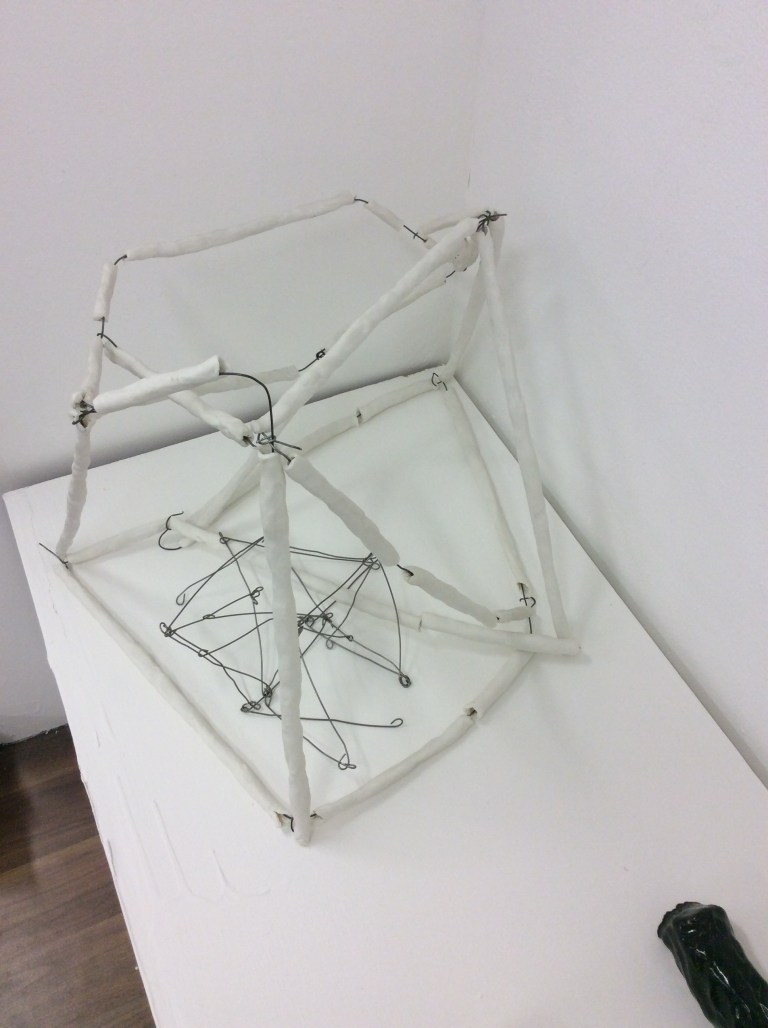
I tried lying the piece in bits on the floor in different patterns.


It was more interesting by still not a drawing in space.
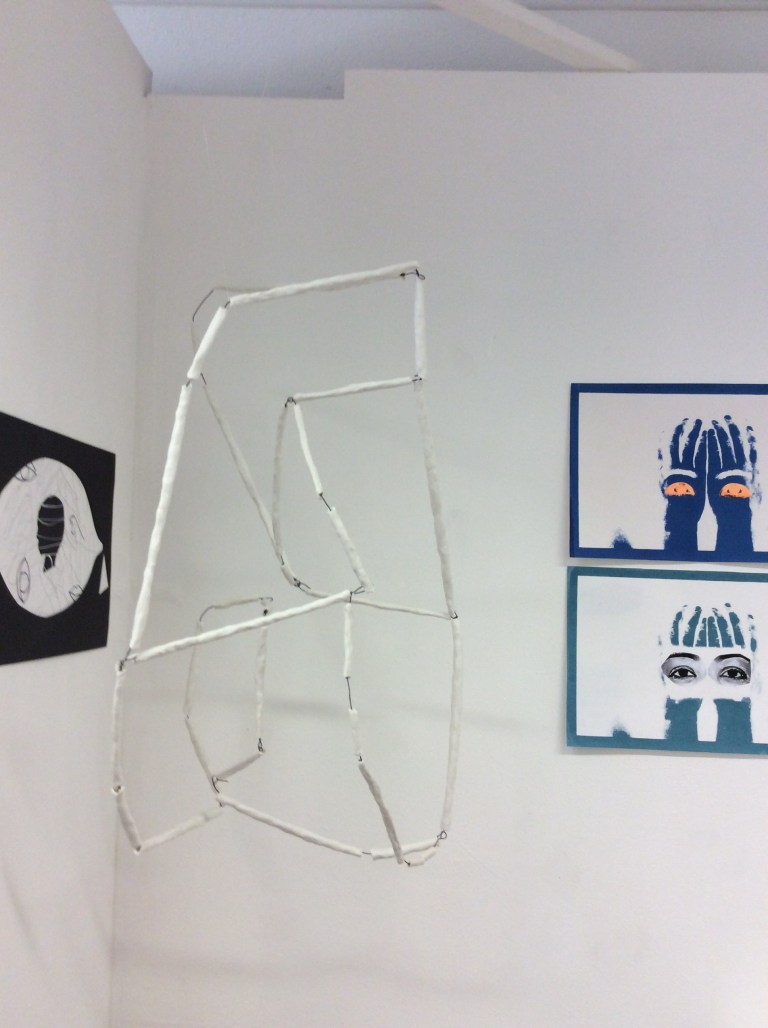
As a hanging piece. This way the piece works much more successfully. I used fishing line to suspend it from a pole attached to the boards used to line the room. Then twisted the wire with pliers. The wire inside looks more like a line drawing in space as originally intended, and the piece itself now looks more like a body or weight in space. The porcelain gives a skeletal effect as if the ceramic is made of bone. On reflection, although it is an interesting exhibit, it would be much more so, with many more pieces of ceramic, which would mean that it could be larger and the lines more dense. Next time, I would aim to do that. The other problem is the lighting, which is not good. It would be much more effective with a downwards light making shadows on the surrounding walls. Next time I would ensure that my work is better lighted.
My final exhibit – a bit of a white out.
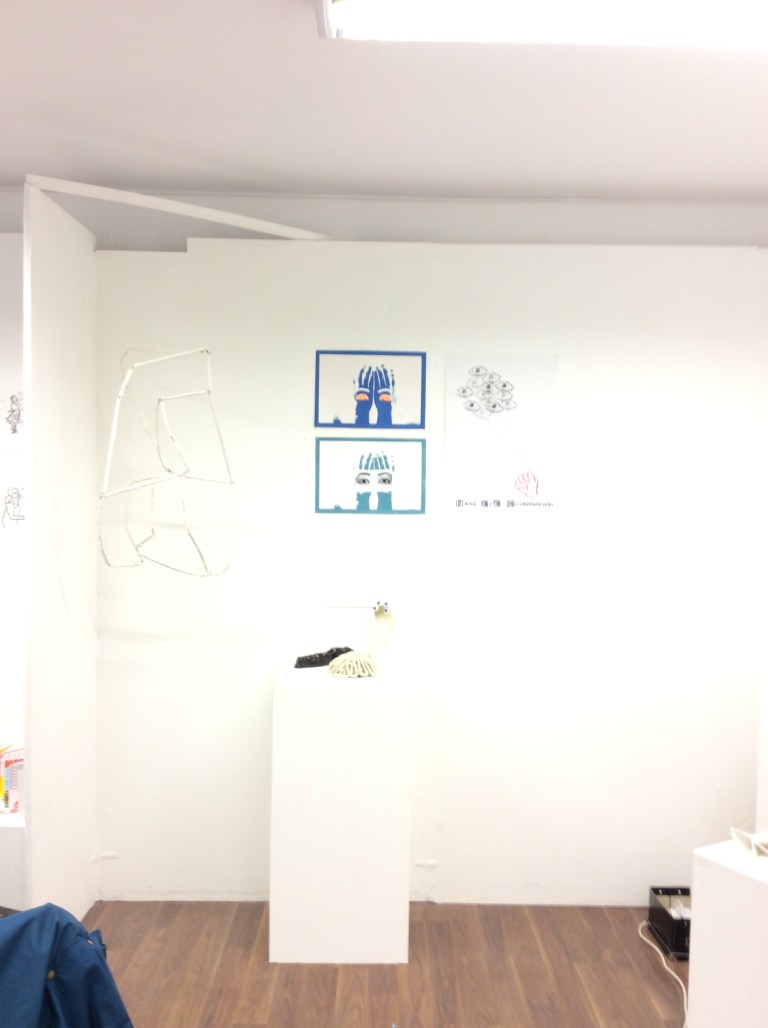
How the shop looked. There was a table in the middle of the room with everyone’s pieces on it made out of different media. Then each person had their own space round the edge of the shop.
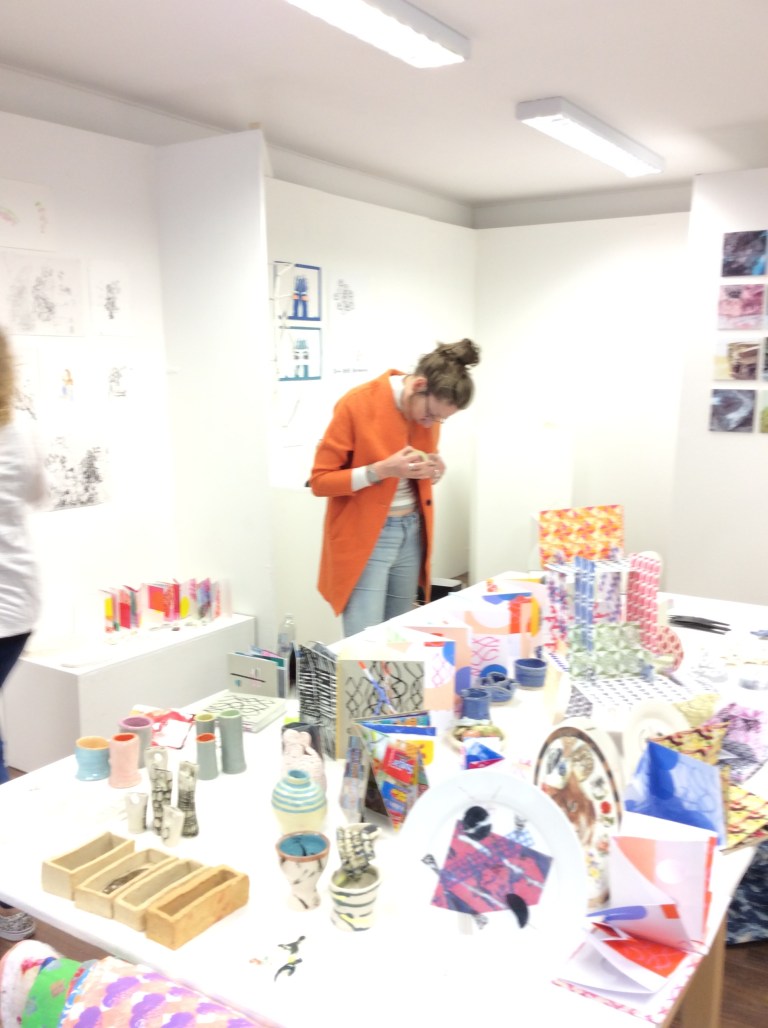 The rest of the Group’s spaces:-
Daisy’s Chapter 2, The Lost Mariner on the left. Elva’s ‘Migrain’ fabric on the right.
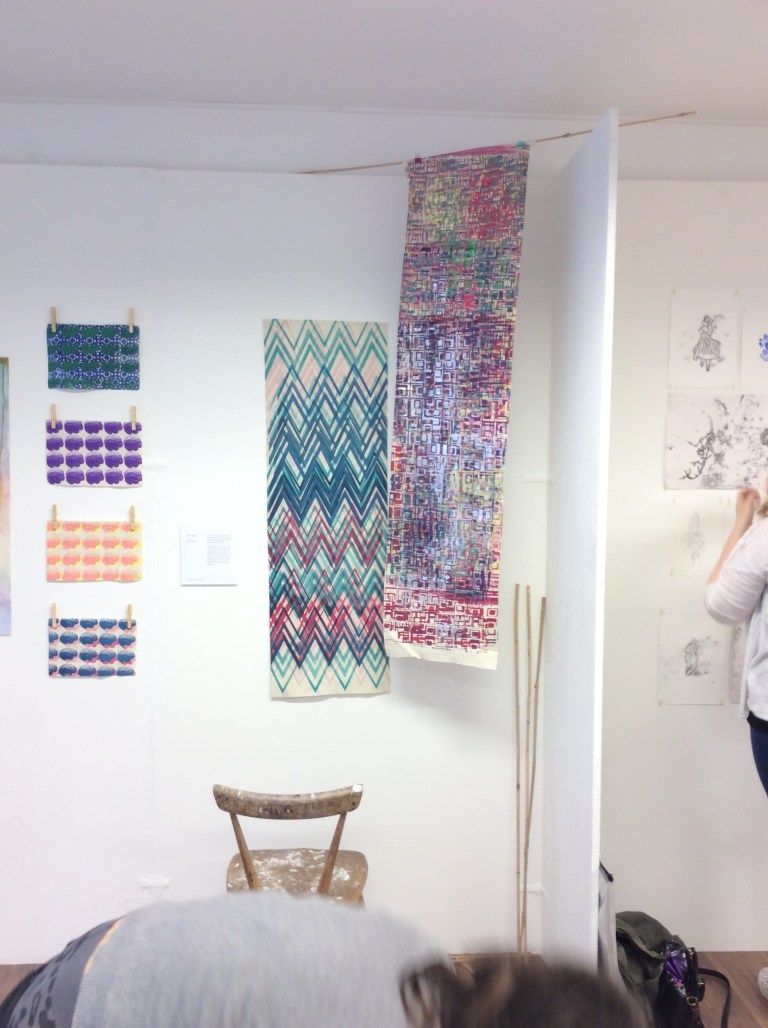
Hayley chapter 6, Phantoms. Self Image.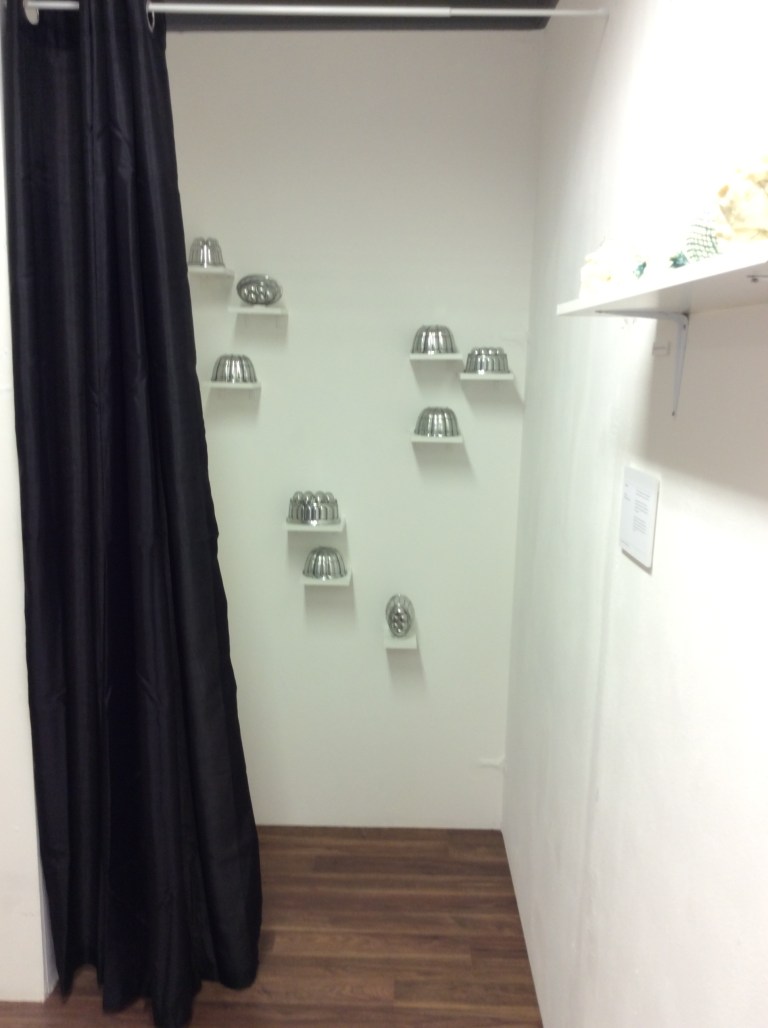 Joanne Parkinsons disease.
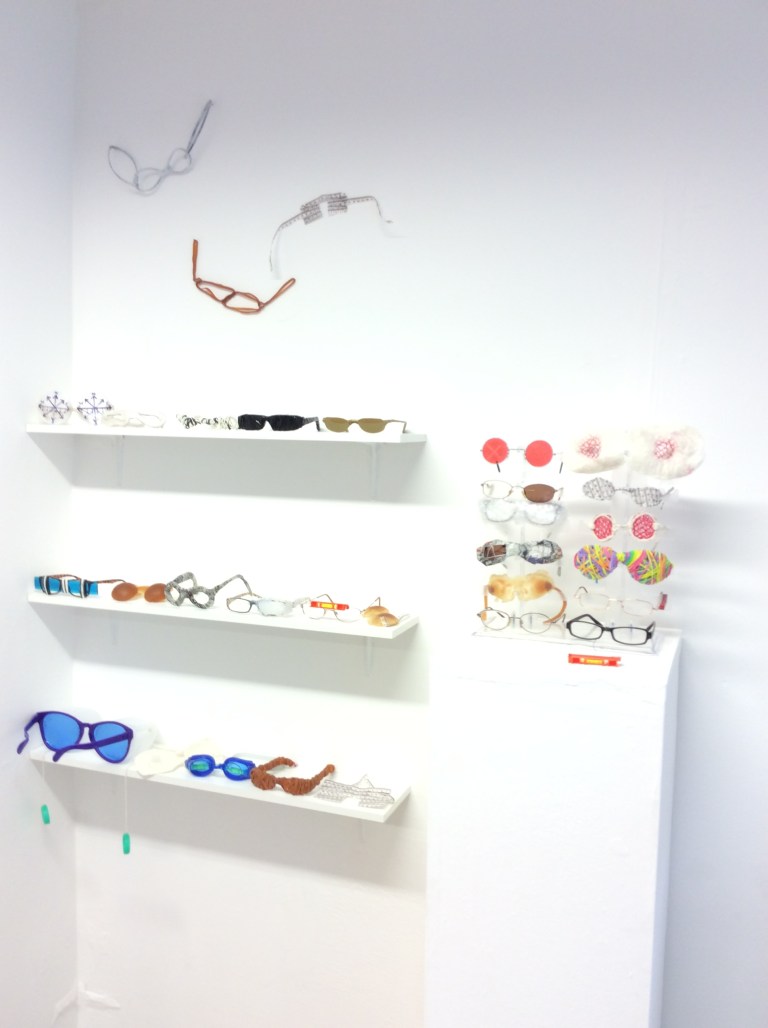 Nor, Chapter 11, Cupid’s disease.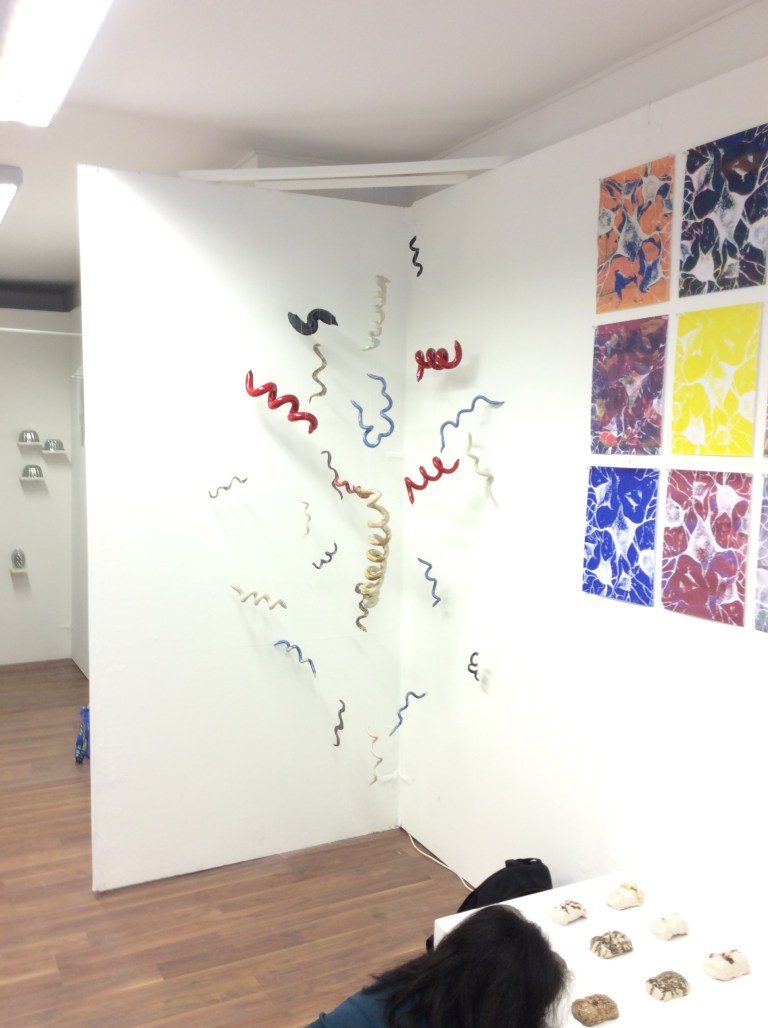
Victoria. Chapter 21, Rebecca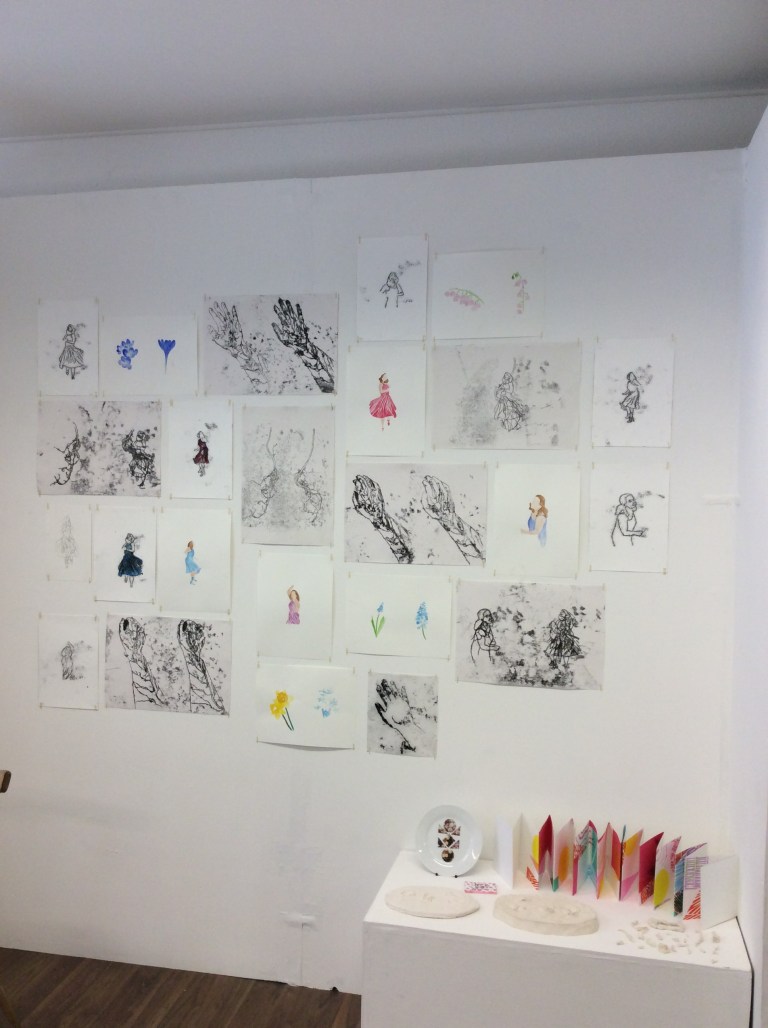
Gerry. PTS.
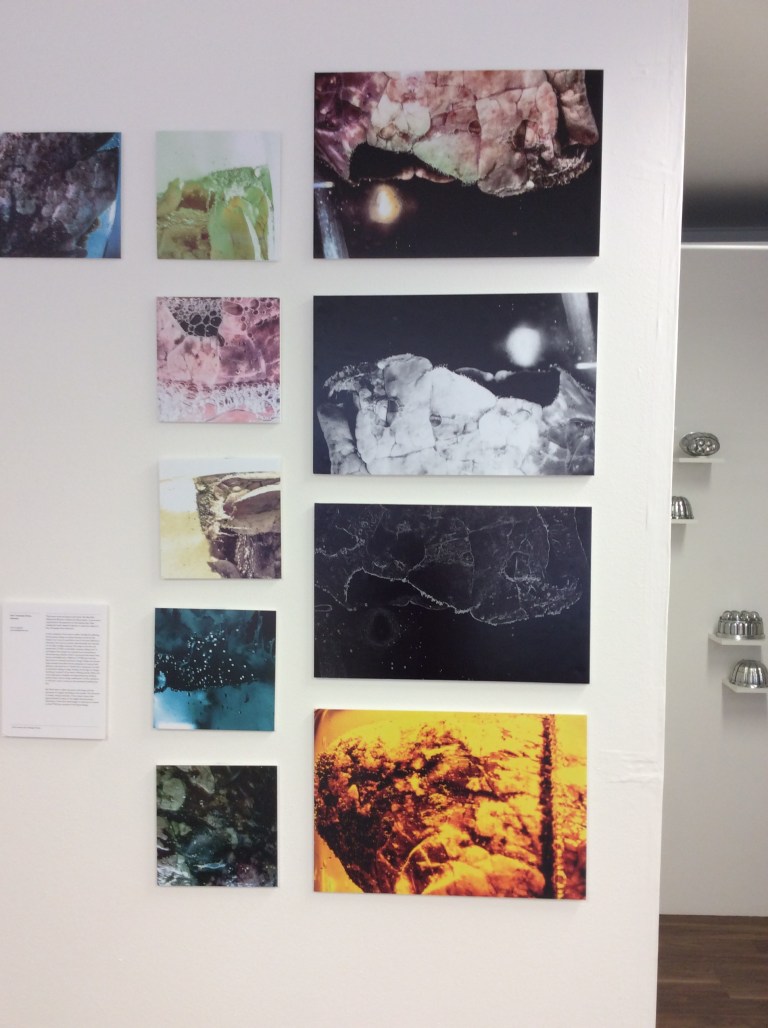
Altogether there were 8 of us showing our work, and everyone had picked a different chapter from the Oliver Sacks book. This gave a unified look to the exhibition. Neil Mabbs had printed out our descriptions of our main pieces – see at the side of the photo above – which gave a more professional look to our exhibits. They were all hung at the same height. After setting up our spaces, we cleaned up, and the shop looked spotless. On reflection perhaps we should have planned more ahead. Certainly people were nervous, and at times there was a tense atmosphere. Some people’s work took longer to install than anticipated, and some had to rely on others to install their work.. But as we were not selling our work, it took a lot of pressure off, and has given us a good idea of what future exhibitions would be like.
The Opening Night seemed to go well and many friends and relatives came.As it was a Summer night, we gave them Pimms to drink – everyone enjoyed the exhibition.
 anita21718