
The day began at 10.00 when we were welcomed with refreshments and played some games. We were then taken to see the Museum shop. I had seen it before when I did my initial research, it is rather dark and under the stairs – quite small too. Apparently the shop is being refurbished and made bigger. But the Museum is constrained by its size and the fact it is Grade 1 listed so there are planning restraints. The stock is not vast and the average spend is around £14 which is not bad. After questions, we were taken back for a talk given by Lucia Lobo. Lycia is Commercial Director of the Ashmolean Museum. She gave a very good talk, the Ashmolean has analysed its products from every angle. The Museum helps promote the University of Oxford. It costs £10m annually to operate. One of the ways it raises money is through the Museum shop.The commercial department’s key focus is ‘visitor spend’. The Museum has 850,000 visitors annually of which 12% visit the shop, but people also buy on line, and the average spend is considerably more. The best selling line is jewelry. The Ashmolean has taken designs for its products from its vast collection, all is factory made. We were shown examples of its ‘signature’ ranges such as the Octopus design from a ceramic found in Crete or Iznik and Indian patterns. Presenting the merchandising is also key and great trouble is taken with displays and packaging. Price is also key. We were shown some jewelry and asked why the pieces had sold well. Overall extremely professional, I am amazed that an average of only 12% of visitors visit the shop, although that is over 100,000 visitors a year.
After this talk, we were taken to the Old Fire Station arts center gift shop. The contrast is very obvious, as all the products are hand made. There are cards, prints, framed pictures, jewelry and small ceramics, it was most charming. But I suspect that the footfall is much less than the Ashmolean and that the shop makes much less money – perhaps its running costs are less, or it has a proportionately bigger grant.
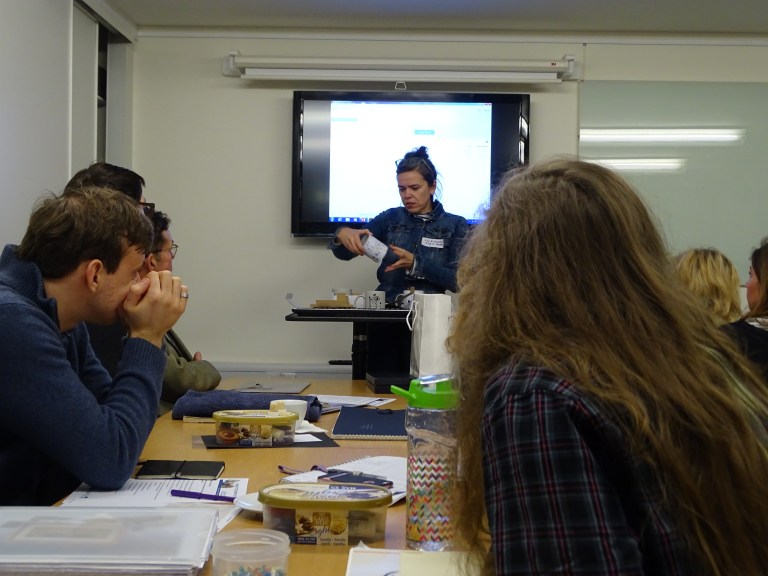
After lunch we went back to the Museum and showed our products to the Panel, which consisted of :- Dr Silke Achermann (Museum Director, Iva Nedyakova (shop), Miranda Millward (Oxford University Arts Co-coordinator),Harriet Rutter (Old Fire Station Shop Manager), and Chris Parkin (Lead Education Officer). As there were so many of us (years 2 and 3 Banbury plus some Royal College of Art students), we were given a 3 minute time slot. There was a wide diversity of products, not one the same, every one seemed to have picked on something different in the Museum. The brief being to pick on something of interest in the Museum which could be made into a product to sell. Products ranged from cards, ceramics, puzzles and games to an ‘Angel Catcher ‘ A mechanism to catch Angels which did not hurt them! I wasnt sure what connection it had to the Museum exhibits.
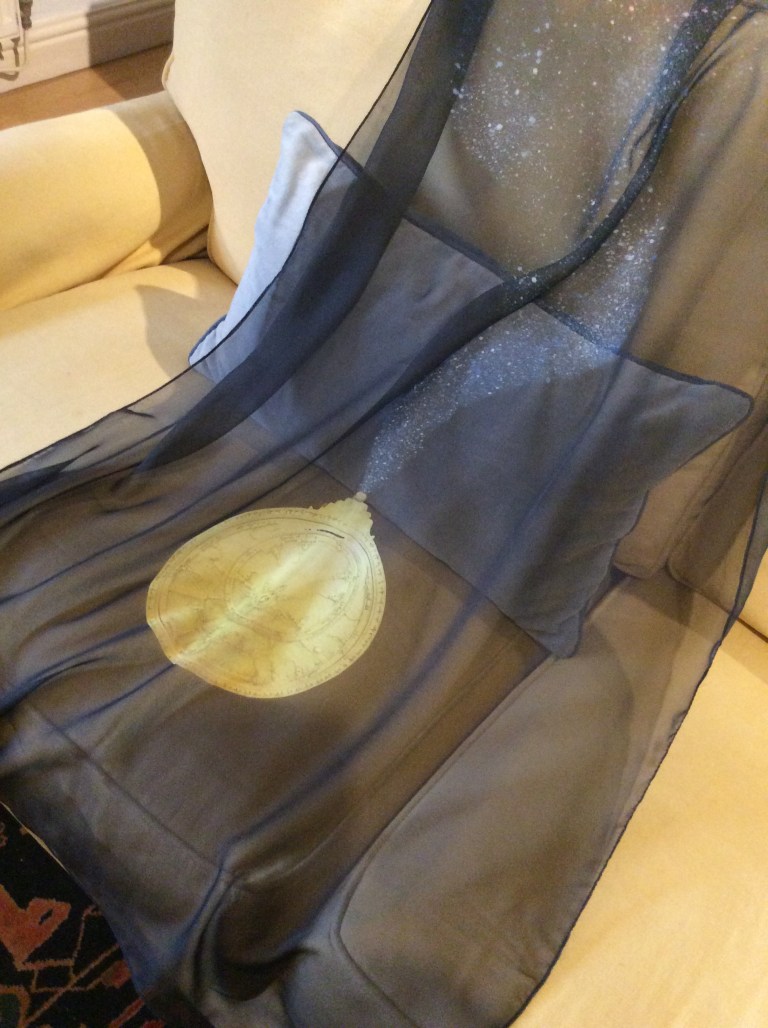
I had had 3 ideas, but choose one because of the time restriction, and I wanted to keep it simple. I choose a large picture of an Astrolabe on a black background with the milky way coming out of it. It could be a large advert for the Museum or wrapping paper or a scarf. I intend to develop it as a scarf.
Afterwards, we were shown round the Museum, and allowed to handle some of the precious Astrolabes and a small sun dial goblet. Overall a very good day and we learnt a lot about selling products.
Some months later we came back to the Museum to show what we had made, as we went in separately, I did not see what other people had produced. We had had a pre presentation previously, but that was at a very early stage and no one had actually made anything.

This was my original design. Astrolabes were, in their time, were very valuable objects, as they charted the stars and planets, which nothing else had done before. The idea here was that from them came Man’s knowledge of the stars. It would make a beautiful scarf – you could be wearing the stars on your shoulders! Below is a photo of my scarf.
 anita21718